



9th grade
Activities:
- • Trace Earth’s ancient history with an animated timeline
- • Explore the Miller-Urey experiment and its groundbreaking results
- • Examine the challenges scientists faced in recreating life’s building blocks
- • Investigate four key hypotheses about the origin of life
- • Place major events in order on an interactive timeline—from the Big Bang to humans
- • Reflect on a thought-provoking question: how does evolution create complexity in a universe where entropy increases?
Activities:
- • Discover how local ecosystems connect to a global biosphere
- • Explore life in extreme environments like deep-sea hydrothermal vents
- • Reflect on the ambitious goals and outcomes of the Biosphere 2 experiment
- • Investigate the meaning of noosphere and cacosphere, and where humanity might be headed
- • Conclude with a reflective quiz that ties together science and critical thinking
Activities:
- • Explore the microbes living on human skin and distinguish between permanent and temporary inhabitants
- • Read about and investigate the diverse microflora of the mouth, scrolling through an extended explanatory text
- • Examine the bacteria of the large intestine and compare them with oral and skin communities
- • Complete an interactive sorting task: drag and drop the labels of different microorganisms (including bacteria and Candida) to their correct positions, gaining or losing points depending on accuracy
- • Perform a habitat-matching task by placing each microorganism where it belongs—mouth, large intestine, or skin
- • Try a hands-on activity: prepare a slide of dental plaque, stain it with the Gram method, and observe it under a microscope
Activities:
- • Explore triggers that activate the immune response
- • Learn about innate versus adaptive immunity
- • Discover the causes of allergies
- • Watch a humorous animation explaining immune system functions
- • Complete exercises to reinforce key concepts
- • Tackle intriguing historical questions related to immunology
Activities:
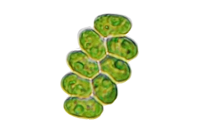
- • Sort different algae into major groups
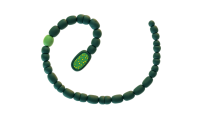
- • Explore how cyanobacteria are sometimes included among “algae” as photosynthetic prokaryotes
- • Place algae into their diverse habitats—from rivers, lakes, and oceans to sloth fur, sea anemone tentacles, and even mountain snow
- • Practice identifying algae with a teaching key based on real specimens used in lab work
Activities:
- • Identify photosynthetic prokaryotes and learn why not all of them produce oxygen during photosynthesis
- • Study cyanobacterial akinetes and heterocysts and their roles in survival and nitrogen fixation
- • Examine a phylogenetic tree to locate photosynthetic prokaryotes
- • Explore symbiogenesis: how chloroplasts originated and how similar they remain to free-living cyanobacteria
- • Analyze absorption spectra of bacteriochlorophyll, chlorophylls a and b, carotene, fucoxanthin, phycocyanin, and phycoerythrin
- • Complete assignments to find absorption maxima and discuss questions like: Can cyanobacteria survive underground? Why is grass green? How effective are red-blue grow lights for plants?
- • Engage with an interactive electromagnetic spectrum task, linking wavelengths to real-world objects
- • Compare the chemical structures of pigments (chlorophyll vs. hemoglobin, bacteriochlorophyll vs. chlorophyll, carotene vs. retinol, phycocyanin vs. phycoerythrin) and identify the closest relative to fucoxanthin
- • Investigate the depth limits of red, green, and brown algae in ocean environments
- • Summarize their understanding of photosynthesis as a biological process in the final challenge
Careers That Use a Microscope
Activities:
Activities:
- • Reveal faint fingerprints and match them to a database through a forensic microscopy challenge.
- • Examine real and fake sapphires, identify inclusions, and determine gemstone authenticity.
- • Compare healthy and cancerous tissues under the microscope to spot structural differences.
- • Match real biological samples to simplified textbook diagrams.
- • Analyze rock thin sections, observe pleochroism, and determine which minerals change color.
- • Explore fermented dairy products to check whether they contain the necessary microorganisms.